

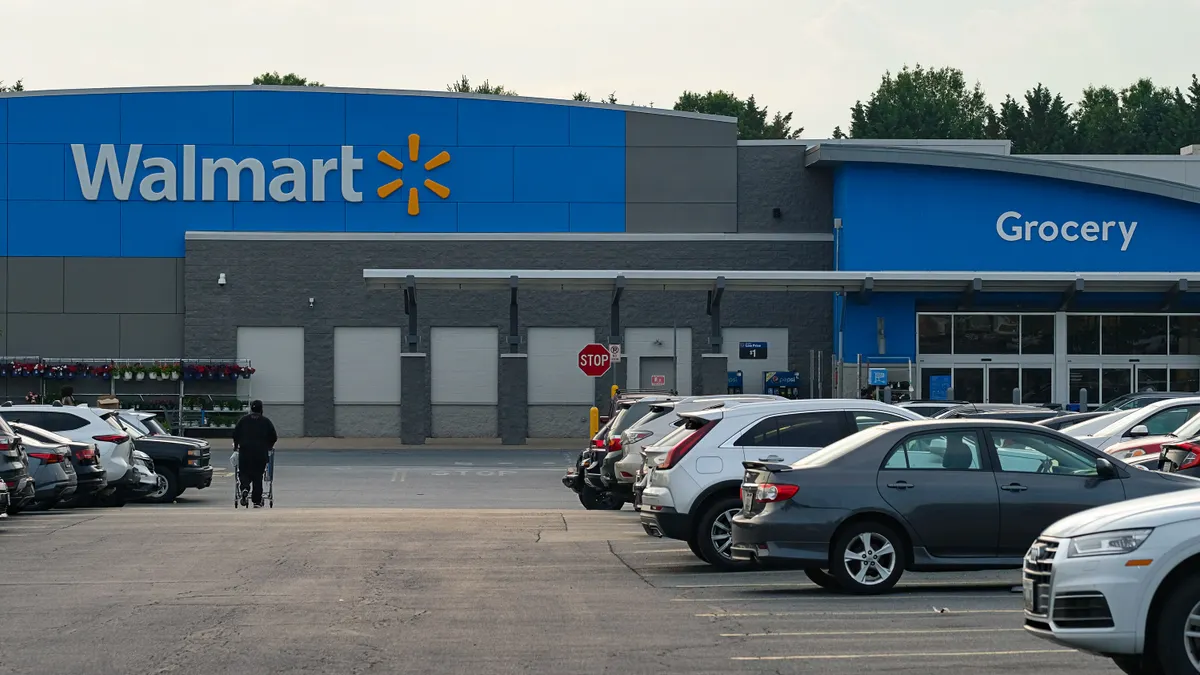
Walmart’s U.S. e-commerce business is booming and Supercenters are making a comeback, its annual report from Friday shows.
The company’s growth during the 2026 fiscal year came as it continues to navigate a technological evolution in the retail industry.
“We are at a pivotal moment, not just for our company, but for the industry, as artificial intelligence fundamentally reshapes how customers shop and how associates work,” Walmart CEO John Furner said in a statement. “We are harnessing its power to enhance our business, guided by our foundational values of service, excellence, respect, and integrity. In this new era, our purpose positions us to set the standard – making it a perfect time to be an omnichannel retailer dedicated to helping people save money and live better.”
Here’s a look at some notable numbers from the retailer’s fiscal year 2026 filing:
Walmart’s U.S. e-commerce grows
Walmart U.S. e-commerce sales positively contributed 4.3% to fiscal year 2026’s comparable sales. That marks an increase from the 2.9% positive contribution to comps in fiscal 2025.
The growth was primarily driven by store-fulfilled pickup and delivery, per the company’s 10-K filing. Total Walmart U.S. comps increased 4.3% for the fiscal year, marking a slight drop from 4.8% growth in fiscal 2025.
Total revenues for the year increased 5.1% to $715.9 billion on a constant currency basis, driven by outsized global e-commerce growth of 24% to $150.4 billion, per Furner’s shareholder letter.
The economics of e-commerce margins are improving, according to an emailed note from Jefferies analysts on Friday.
“Incremental e‑commerce dollars carry higher margin than stores as routing, batching, and express fees scale,” the analysts said based on a meeting with Walmart investor relations. “About one‑third of deliveries include an express fee, and network density continues to bend profitability positively. Management is increasingly focused on total volume per store, not isolated in‑store comps.”
Continued investment in new stores and technology
Walmart continued growing its allocation of capital toward new stores and clubs — including expansions and relocations — in the U.S. Investment in the category increased about 212% year over year to about $1.4 billion for fiscal 2026, marking the largest investment increase across all of its investment categories.
That builds on the company’s fiscal 2025 new store investment growth of 500% year over year in the U.S.
However, Walmart’s largest share of allocation of capital expenditures continued to be in its U.S. “supply chain, customer-facing initiatives, technology and other” category, which was up nearly 13% in fiscal 2026.
Agentic AI — including its customer agent Sparky — was a core focus for the retailer this past year and Furner’s appointment is partly built on the idea that he can lead the company through AI-driven change. Sparky drives about 35% higher baskets for users, according to the Jefferies analyst note.
“[Management] views a shift toward agentic, contextual commerce, where authenticated [Walmart] data provides an advantage,” the analysts said. “AI is framed as a demand‑capture and frequency tool, not a paid traffic strategy.”
Supercenters return to growth
Supercenters saw the most store growth in the U.S. for Walmart, with the retailer adding seven to its fleet compared to fiscal 2025’s ending count. That compares to a slight decrease in the number of Supercenters from fiscal 2024 to fiscal 2025.
Walmart opened its first new Supercenter in four years in April of 2025. The Cypress, Texas, location was also its first under the “Store of the Future” model in the U.S. and caters to regional preferences with a Hispanic bakery section and a fresh tortilla maker.
The company’s total U.S. unit count grew less than 1% year over year, coming in at a total of 5,212 locations inclusive of Sam’s Clubs.